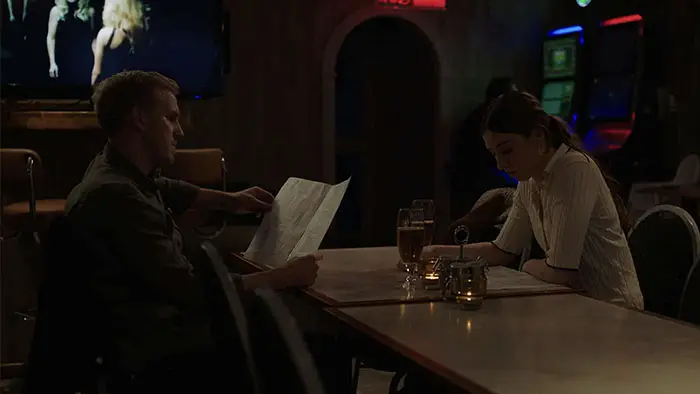
Alive boasts gorgeous visuals and sound design that deeply immersed me in the world. Shallow focus and soft lighting worked well to enhance the intimate narrative. The sound design enhanced the characters’ voices, giving every strained word that Victoria uttered a powerful presence. The charming dialogue and the powerful performances from Johansson and Martin instantly endeared me to the characters. Additionally, there was solid pacing with a clear progression of Victoria’s character from the beginning of the story to the end.
The flaws started to reveal themselves when I posed the question of “who’s story is this?” Victoria is the protagonist who drove the narrative with her actions and changed with them, but those actions are largely passive. Victoria confessed to Ida about wanting love, which led Ida to make her a Tinder profile. Victoria invited a scary looking man over that she met on Tinder, and Ida insisted on staying with her, but Victoria screamed, which caused Ida to remain outside. This is further confounded by the framing of moments, which always showed the events from Ida’s perspective. For example, when Ida is forced to be outside while Victoria has her date with Håkan, the camera showed this moment from Ida’s perspective, not Victoria’s. However, these scenes that only follow Ida don’t add anything to her character. Ida does not change as a person throughout the narrative. This left the film less emotionally resonant because the protagonist is not the subject of focus. The subject of focus does not grow or change in the short’s runtime, which in turn left the focus of the short muddled and dampened the power of its story. Alive didn’t leave me emotionally invested in the characters themselves, but very few movies come close to humanizing disabled people, so this short is rare in presenting a fleshed-out disabled character. That doesn’t excuse the film’s shortcomings. Still, it will hopefully serve as an example for how to write disabled characters and portray them on screen well, and prove that a humanizing and empowering story about a disabled person is possible.